
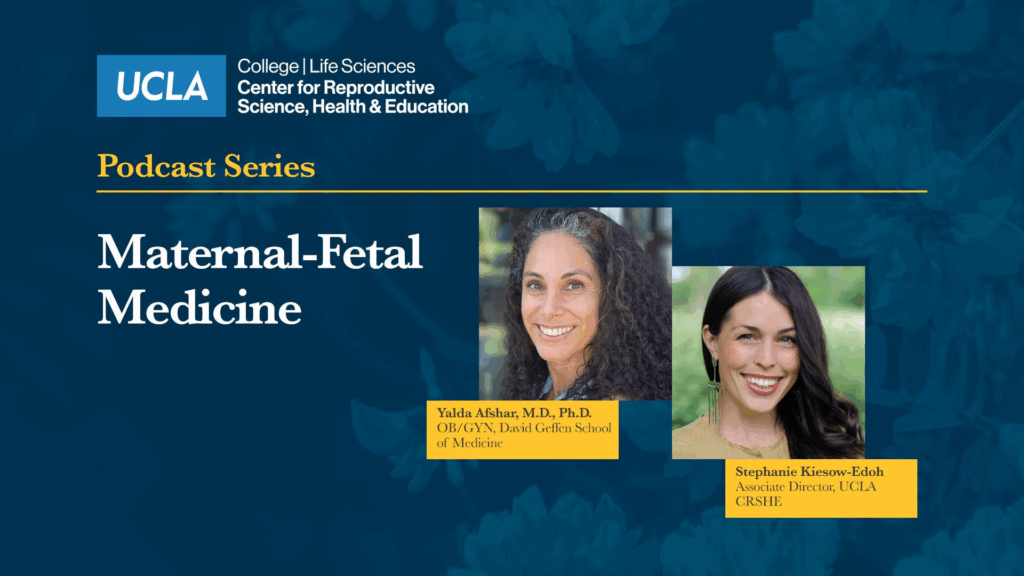
In this episode, Stephanie sits down with Dr. Yalda Afshar for an illuminating conversation that bridges the worlds of clinical care and cutting-edge science. Dr. Afshar shares her journey as a physician–scientist, tracing the evolution of her research in maternal–fetal health and revealing how the patients she cares for inspire the questions she pursues in the lab. She recounts cases that have shaped her perspective, offers a compelling look into the rising concerns around placenta accreta and its link to cesarean sections, and paints an exciting picture of where the field is headed next. This episode offers a thoughtful, dynamic exploration of the future of maternal–fetal medicine.
Curious about a specific topic? Here’s what we cover:
00:22 – Introduction to Dr. Yalda Afshar
01:45 – The Trajectory of Dr. Afshar’s Research and Lab
03:00 – Overview of the Field of Maternal-Fetal Medicine
04:05 – The Role and Lifestyle of a Physician Scientist
07:38 – The Importance of Mentorship
10:00 – Types of Patients Who See Maternal-Fetal Medicine Specialists
11:10 – Impactful and Challenging Cases
13:22 – How Clinical Practice Informs Dr. Afshar’s Research
16:05 – Placenta Accreta and Cesarean Birth
20:07 – Future Directions
Resource
National Accreta Foundation (https://www.preventaccreta.org/)
Dr. Yalda Afshar
The Afshar Lab (https://www.theafsharlab.com/)
Biography
Yalda Afshar, M.D., Ph.D. is a physician-scientist in the Division of Maternal Fetal Medicine, Department of Obstetrics and Gynecology at David Geffen School of Medicine, UCLA. Clinically, she manages the care of pregnancies complicated by cardiovascular disease and congenital heart disease that affects either the pregnant person or the fetus. She is the co-director of the UCLA Cardio-Obstetrics program. In the Afshar laboratory, the team focuses on the cardiac-placental axis, specifically in order to understand the biology and pathophysiology of normal and abnormal placentation during pregnancy and how this modulates the life-course. All this to say, her team is focused on clinically relevant research to improve care, access, and an understanding of biology to improve the health of pregnant people and their babies today, tomorrow, and in the future.